

.⋆。⋆༶⋆˙⊹ Today, I’ll be interviewing Katrina Dodson: an acclaimed writer and translator from the Portuguese (fun fact: she’s also my aunt!).
Dodson translates from Brazilian Portuguese. Her translation of The Complete Stories, by Clarice Lispector, was named a New York Times Notable Book and won the 2016 PEN Translation Prize, the American Translators Association Lewis Galantière Award, and more. Her new translation of the 1928 Brazilian modernist classic, Macunaíma: The Hero with No Character, by Mário de Andrade, was published in April 2023 by New Directions and Fitzcarraldo (UK).
Dodson holds a PhD in Comparative Literature from the University of California, Berkeley and is an affiliated scholar of the Brazil LAB at Princeton University. A San Francisco native, she now lives in Brooklyn and teaches translation in the MFA in Writing program at Columbia University.
· • —– ٠ ✤ ٠ —– • ·
Alexa Jeong: How did you begin translating from Brazilian Portuguese, and what drew you to the language and/or culture?
Katrina Dodson: When I first started translating, it wasn’t Brazilian Portuguese. I actually first started translating in my Latin class, and I think that was my first major experience with translation. Because all you do in Latin class is translate—often from Roman writers like Catullus or Cicero. This was in graduate school by the way; I was getting a PhD in comparative literature at UC Berkeley when I got interested in translation.
But I’ll give you the full timeline, okay?
So I graduated from college, U.C. Berkley as an undergrad. Then I moved to Brazil just to live and teach English in 2003, and I stayed there for a year and a half. I took classes at the local university—it’s called Pontifícia Universidade Católica—and because I was a literature person, I said, “Okay, I’ll take the literature course and this communications course”. It was basically just fast-tracking learning Portuguese, and because I was taking classes with all of these undergraduate Brazilians, I learned it pretty quickly.
That’s also how I learned a lot about Brazilian literature. There was a lot of great stuff that wasn’t translated into English—or it was, but the translation wasn’t very good. So I applied to grad school for comparative literature, and I started at Berkeley again in 2005. That’s where I took Latin, because it was a requirement.
I think it was 2009 when I started thinking about literary translation as a profession. Not necessarily as my main career, but just as something that you could do for money, just outside of pleasure.
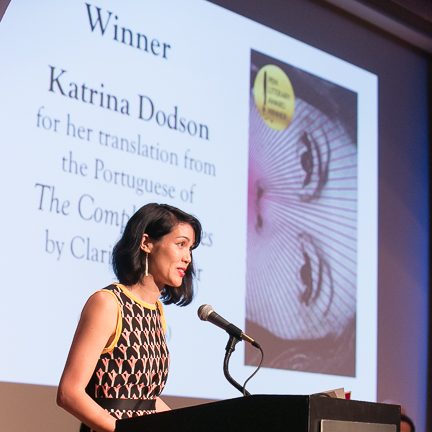
I hadn’t been planning on becoming a literary translator. Of course you’re aware of translations and translators, but I don’t think a lot of people imagine it as a career. They don’t always say “Oh, when I grow up, I want to be a literary translator”.
AJ: That’s true…
AJ: So going off of that, in your opinion, what makes the art of translation so special?
KD: I think it’s special because it’s very familiar and it’s something that all of us have some experience with. Even if you don’t speak another language, you could translate your particular kind of English or slang into another form of English.
And so I think it’s something that seems very intuitive and everyday, but at the same time, it’s very mysterious, because you realize that one word can never equal another word. In many ways, translation is an impossible task, since most people think about it as forming this equation in which one set of words equals another set of words.
Especially when you’re working with literature, texts have a lot of meaning embedded in the form and in the sound of the words, creating a particular set of associations and moods and emotions. So when you’re working with words as an art form, it becomes a very complex process, and I think it’s a lot more creative than people realize.
It’s a little bit controversial, this question of whether translation counts as writing, and I think it’s definitely writing, but it’s writing with constraints. Because it’s not inventing from scratch. You’re definitely practicing an art, but you’re not speaking in your own voice. You’re kind of speaking in a double voice—so it’s you and it’s not you.
People always resort to metaphors and comparisons when they talk about translation, because translation is so slippery when you’re trying to figure out what it is and what it’s meant to do.
I talk about translation as a performance. I say it’s like an actor performing a script, or a musician playing music. These are both art forms in which you’re interpreting a work that was composed or written by somebody else, but you’re adding your own performance aspect, and a lot of it is very improvisational.
Even though it’s printed words on a page, you make a lot of decisions in the moment, based on your particular intuition for how to create a certain effect that you’re trying to get. And often it’s not just intellectual. It’s this mix of feeling and intuition.
AJ: To be honest, I feel like when I would read novels that were translated into English, I would just gloss over the translator’s name and not think much of it.
But even though translators aren’t responsible for, say, the plot or the storyline, they’re still responsible for the feel, the tone, keeping the authenticity of the original text… and I feel many people often forget that.
KD: But also, I think that people often don’t want to think about an important work of literature being translated, because it’s upsetting. You could say, “Oh, I’m not really reading Dostoevsky”, or “Oh, I’m not really reading Clarice Lispector, I’m just reading what Katrina Dodson thinks Clarice Lispector said…but what if she’s lying to me? What if she made a mistake?” It starts to point to a real instability of authorship, and I think it’s unsettling for some people.
Introduction from http://www.katrinakdodson.com/
 THE ORCHID